

Pittsburgh students are helping document allyship and local responses to antisemitism
In the city where the #bethekindkid movement was born, a local program is honoring neighbors who are making a difference. And students are playing a valuable role.
“We were finding that there were a lot of non-Jews in our network really working to support the Jewish community, but often they don’t know just how significant of an impact they’re making,” said Noah Schoen, community organizer and oral historian who leads community engagement at the Holocaust Center of Pittsburgh
That impact from neighbors from different corners of the region, says Schoen, became the starting point for the Righteous Among the Neighbors, created in 2023 by the Holocaust Center of Pittsburgh.
Each year, the event brings Pittsburgh residents together to recognize non-Jewish community members who have supported their Jewish neighbors and spoken out against antisemitism. At the public ceremony, honorees are called forward and their work is described to the community.
Emily Loeb, director of the Holocaust Center of Pittsburgh, describes the event as only one layer of the program: “There’s the public celebration,” Loeb says, “and then there’s all the work that happens behind the scenes.”
Schoen said the program was created in response to two parallel realities. On one side were Jewish community members living with rising anxiety as antisemitism intensified, looking for signs that their non-Jewish neighbors understood what was happening and were willing to stand beside them. On the other side were non-Jewish residents who were already doing that work, sometimes behind the scenes, often locally, and not always fully aware of how much their efforts mattered to the people receiving them.
The program was designed to close that distance. It would make those acts of allyship visible to the Jewish community, while also expressing gratitude to the people carrying them out. It would recognize that support publicly, while also documenting it.
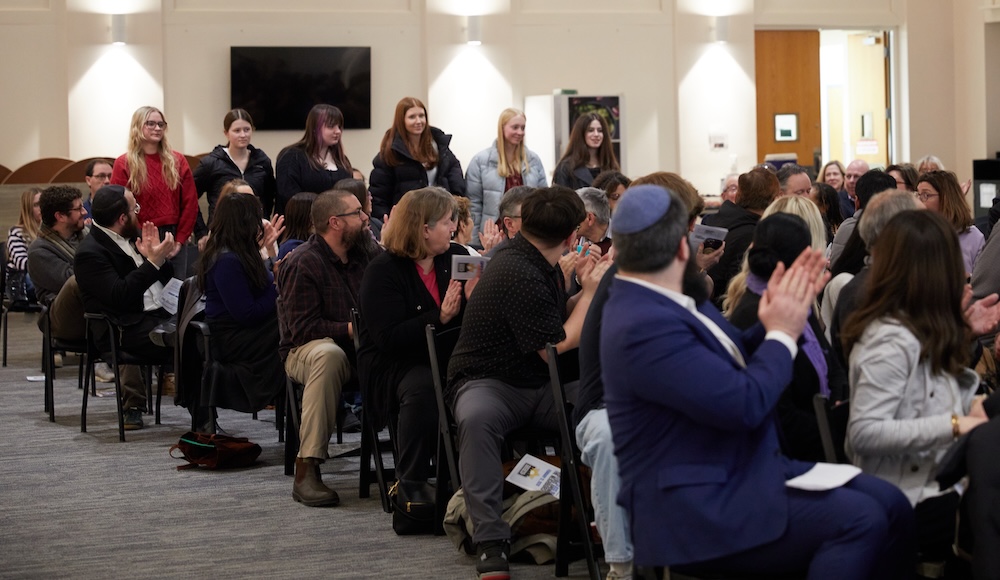
Using Journalism to Document and Celebrate
An important part of the documentation is done by Pittsburgh area students, who take on the role of journalists, through a partnership with the LIGHT Education Initiative and Mt. Lebanon High School. They interview each honoree and write full profiles based on those conversations. Over three years, students have produced more than 40 stories, published in outlets including the Pittsburgh Jewish Chronicle and Pittsburgh City Paper, as well as on the Holocaust Center’s website.
Schoen said involving students was part of the design of their program: “What if we were able to turn this into an opportunity for students to show leadership and make an impact on a real-world issue?”
The work is guided in the classroom by English teacher Dawn Davenport. When Davenport introduced the project, she let students know: They wouldn’t be writing for a grade alone. They would interview people whose work mattered in the community and produce stories that would be read beyond the classroom.
“This is a real-world experience,” Davenport says.
For most school assignments, a student writes, a teacher grades, and the work ends there. Real journalism, she says, “has a product. And that product is viewed by the community.”
Also, this subject matter requires a different kind of care. In the program’s early years, many of the conversations were closely tied to the aftermath of the Tree of Life synagogue shooting. Students often began by asking about that moment and how people responded to it. Over time, Davenport said, the focus has widened.
The program now highlights a broader range of community members, including people whose work might be less visible but just as sustained. This year, Davenport says, students also interviewed the people who nominated the honorees, which helped build a fuller portrait of why each person mattered and how their work was seen by others.
Students also had to account for language and sensitivity, while encountering a constant stream of information online — much of it conflicting and emotionally charged. Davenport is not Jewish, and said she relied on Schoen’s guidance on points of framing and accuracy, including how to talk about the Tree of Life building in a way that was respectful and inclusive.
“We were really looking at how to even say ‘the Tree of Life,’” she said, noting that students needed to understand the history and the structure of what they were referencing. “There was definitely learning along the way.”
“It got very hard,” Davenport said. “We had to keep re-centering on what this project is. We’re recognizing what people are doing for each other.”
Rather than asking students to engage at the level of global politics, Schoen says, the focus is on what happens locally and connecting larger issues to individual people.
“When you make real human connections and connect the topic to real people, that’s how you overcome a lot of that confusion,” Schoen said.
For students, the challenge is not only understanding those ideas. It is shaping them into stories, and getting comfortable with interpreting and condensing what they learn: “The biggest struggle the kids had was pairing this down to an 800-word story,” Davenport says. “They’re talking to people who have done this work for their entire lives, and they feel like every word is important.”

Making the Effort to Understand
Davenport said that discomfort is part of what makes the project meaningful. These are not professional reporters. They are teenagers carrying full school schedules, extracurriculars, family demands and, in some cases, mental health struggles. They are doing this while taking AP classes, playing sports and trying to meet deadlines that matter.
What continues to strike her, Davenport says, is that they rise to it: “When you give kids something meaningful to do, they’ll do a good job.”
One of those students is Adeline Young, a senior at Mt. Lebanon High School. Journalism, she said, gave her a way to use her love of writing while telling “real stories.”
Young interviewed Bhavini Patel, who was recognized for building connections between Pittsburgh’s Jewish and Hindu communities, and for speaking out against antisemitism. In her profile, Young opened with a vigil scene. Patel is standing among mourners at a vigil in the days following Oct. 7, just listening, and offering a presence of solidarity.
“It was so amazing to see someone so passionate about building bridges among communities in Pittsburgh,” Young said. “Her passion for what she does is so clear and inspiring.”
The interview itself, Young says, was one of the strongest she had conducted. Patel approached each question thoughtfully, which made the reporting rich. Counterintuitively, it also made the writing more difficult. “She answered all my questions so thoughtfully and eloquently,” Young said. “It made my job of picking out quotes a bit difficult.”
To work through that, Young tried to put herself in the shoes of the reader.
Patel found that being interviewed by a student felt different from a typical media conversation. “Being interviewed by Addie felt grounding,” she said. “There’s an honest attentiveness and curiosity that young journalists often bring. They’re not yet completely filtered by preexisting views or professional habits, so their curiosity feels very direct and sincere.”
What stayed with her was the depth of listening: “She wasn’t just asking questions to move the conversation along. She was taking in the answers and responding thoughtfully.”
That exchange shaped how Patel thought about her own work. When she describes it, she often returns to the idea of “radical kindness,” as a practice built through small, repeated choices.
“I view it as a form of steadiness,” she says. “Choosing to speak when it would be easier to stay quiet, or to remain open when being defensive might be more comfortable.”
For Patel, that kind of courage is not about a single moment. It’s about consistency. “Returning, again and again, to the choice to engage with care,” she says.
She also sees value in the question of who is telling these stories. When young people document these stories, they shift the audience and the tone, Patel says. That brought an implicit invitation to be more accountable to the next generation.
The students also found the project eye-opening. Many began with the assumption that meaningful action has to be large or public, Davenport says. “But for most people, it was just noticing that in their workplace or their neighborhood, there were small things to do.”
As they did interviews, that idea changed. “The students were left empowered at the end of the work,” Davenport says, because they realized “everyone we interviewed did something that I could also do.”
Related Stories

Want more kindness and wonder? ‘Mister Rogers’ Neighborhood’ is getting its own YouTube channel

New research shows the lasting impact of “Daniel Tiger’s Neighborhood” on teens who watched as preschoolers

Continuing the Mission: Two Moonshot projects reimagine life after high school
The Children’s Museum of Pittsburgh kicks off a ‘Year of Kindness’ and you can get involved

No mom is alone: NurturePA expands Mom-to-Mom texting service sharing support and encouragement

The Kidsburgh Podcast is up for another Best of the ‘Burgh award! Vote (& hear all 36 episodes) here.

These 3 Moonshot projects are equipping Pittsburgh youth with tools to create their own future

Pittsburgh Parks Conservancy’s new Trackchair program helps everyone enjoy local trails

These local educators have been named Penguins MVPs

In the region Mister Rogers called home, being the kind kid takes center stage at schools

Where everyone is welcome to learn: 3 Moonshot projects connect underrepresented students with career learning

Teaching teachers, the Fred Rogers way: Welcome to frED Camp

Maker Monday: Kids can make these cool ‘kindness rocks’

How Josh and Gab use humor to help kids navigate bullying — and why they call It “pro-kindness,” not anti-anything
Maker Monday: Kids can spread kindness by making yarn-covered hearts
The 3% Rule: One father’s lesson became a family legacy — and it can help you
The Neuroscience of Neighborliness: How kindness changes kids’ brains

At these innovative schools, the pursuit of student happiness is improving engagement and academics
Want to catch up on the Kidsburgh Podcast? Here’s the scoop on seasons 1 and 2.
